AI can build your product. It can’t find your customers.
Shipping has never been easier. Distribution hasn’t moved an inch — and it’s where most products quietly die. Bullseye is a free dashboard for that part: work out which of 23 traction channels could actually bring you users, test the best three cheaply, then commit to the one that pays.
Most products don’t fail at building
A founder can now go from idea to working product in a weekend. What no model will do for you is find the first thousand people who want it — and that gap has never been wider. The result is a lot of finished software nobody uses.
The usual failure isn’t laziness. It’s picking a channel by instinct, pouring months into it, and finding out far too late that it was never going to carry the numbers.
“Almost every failed startup has a product. What failed startups don’t have is enough customers.”
Consider everything. Test cheaply. Commit once.
The framework is deliberately unglamorous, and that’s why it works: you can’t know which channel will work, so stop guessing and run the cheapest experiment that would tell you.
Consider every way in
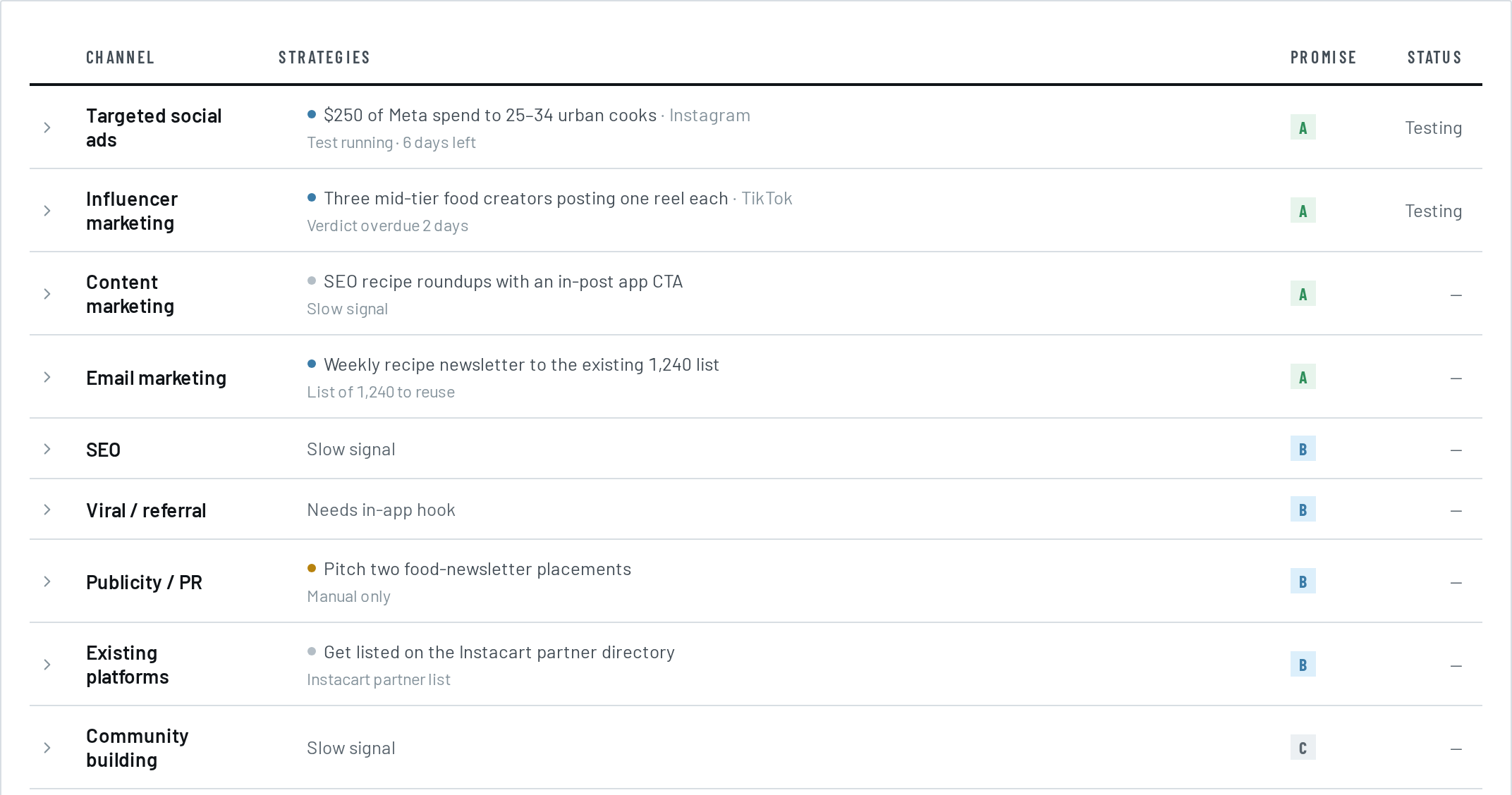
All 23 channels on one board — including the ones you’d dismiss, which is usually where the cheap wins hide. Rate each on promise and write the specific play you’d run.
Cheap tests, hard verdicts
Pick three. Set a budget, a signup target and a deadline before you start, so the result can’t be argued with afterwards. Track spend, signups, cost per customer and who stayed.
Focus on the one that pays
One channel earns your attention. Then it’s about improving it — versions, spend, retention — until it stops paying, and you run the loop again.
The AI is free with a Launch Fury account
Not a trial, not a credit balance. It’s paid for by Launch Fury, so the whole cost to you is signing in — which is also what syncs your projects across machines and lets you put a team on one board.
A strategy for all 23 channels
Describe what you’re building and AI drafts a specific play for every channel — then scores each on impact, confidence and ease so you know which three to test.
A second opinion on your tests
It reads the numbers you’ve actually logged and says which channel it would commit to — or, honestly, which single test would settle it when the evidence is thin.
Where the next dollar goes
Once a channel wins, it reads your versions and spend and says what to double down on and what to stop paying for.
Bullseye is built on the framework laid out in Traction: How Any Startup Can Achieve Explosive Customer Growth by Gabriel Weinberg and Justin Mares. The thinking is theirs. We wanted a place to actually run it — the book gives you a method and leaves you with a blank page.
If you haven’t read it, read it. It’s better than anything we could write about it, and the chapter on each channel is worth more than any dashboard. Find the book →
Bullseye is an independent tool. It is not affiliated with, endorsed by, or sponsored by the authors or publisher of Traction. We’ve added a few channels the 2015 edition couldn’t have covered — answer engines, creator sponsorships, marketplace ads, messaging — and named them clearly as ours.
We needed this ourselves
We’re building Launch Fury — a platform for product teams to plan, build and ship with AI. Which left us with exactly the problem above: a product we believed in, and no idea which channel would bring us users.
So Bullseye is genuinely the board we run our own launch on. That’s the only reason it’s any good: every column exists because we needed it, and the parts that were decoration got deleted. It’s free because it costs us almost nothing to share, and because the people it helps are the people we’d like to meet.